
Criminal screening is no longer a back-office task. It is a business-critical process that directly influences safety, trust, and efficiency. Organizations today face growing pressure to act quickly, whether they are bringing in new employees, approving residents, or onboarding vendors. But speed without accuracy is a recipe for risk. A missed detail in a criminal background check can create operational disruptions, reputational damage, and unexpected costs.
That is why a smarter screening process begins at the county level. County courts are where most felony and misdemeanor cases are first filed, where charges originate, and where records are most reliably updated.
State and national databases can provide breadth, but they cannot match the depth or timeliness of county-level information. By building a process that prioritizes county searches, organizations anchor their decisions in the most accurate and up-to-date data available.
Why is Accuracy Crucial in Criminal Screening?
The volume of data continues to grow each year, and with it, the expectation for fast, thorough, and scalable screening. But when accuracy is sacrificed, the consequences quickly outweigh the perceived benefits of speed.
Approving the wrong candidate or applicant erodes trust among stakeholders. Overlooked details can lead to last-minute reversals, costly rework, and disruption to daily operations. In some cases, the reputational harm caused by a poor decision can linger long after the incident itself.
The Bureau of Justice Statistics has long documented problems with national crime data, noting that local agencies often fail to submit complete or timely updates. In fact, nearly one-third of U.S. law enforcement agencies did not report crime data to the FBI in 2022, leaving significant gaps in the national picture.
Major Differences Between County Criminal Searches and Databases
At first glance, databases appear attractive. They offer the promise of speed, with large volumes of records compiled from multiple jurisdictions. But the quality of that data depends on reporting practices that vary widely across counties and states. Cases may take weeks or months to appear, classifications differ by jurisdiction, and in many cases, participation is inconsistent or voluntary.
County-level searches, on the other hand, go directly to the courthouse. They provide verified, original records that include details such as the case number, the nature of the charge, the filing date, the status of the case, and the disposition, if available. Because most criminal cases originate at the county level, these searches provide the most comprehensive view into an individual’s history.
Databases can still play a role, but not as the foundation of a screening process. They work best as discovery resources that point to additional jurisdictions where further checks may be required. The real depth and reliability come from confirming those leads with county searches.
What County Searches Show and What They Do Not?
A clear understanding of what county criminal searches reveal helps set realistic expectations. Typical county-level results include:
- Full name associated with the case
- Case number and docket information
- Nature of the charge or charges
- Filing date and jurisdiction
- Case status and updates
- Final disposition and sentencing details, if applicable
What county searches generally do not show are low-level traffic infractions, sealed or expunged records, or federal offenses that are handled in a separate system. By knowing precisely what to expect, organizations can design a process that utilizes multiple sources in a structured manner, without assuming that any one type of search is fully comprehensive.
How to Structure an Effective Screening Process?
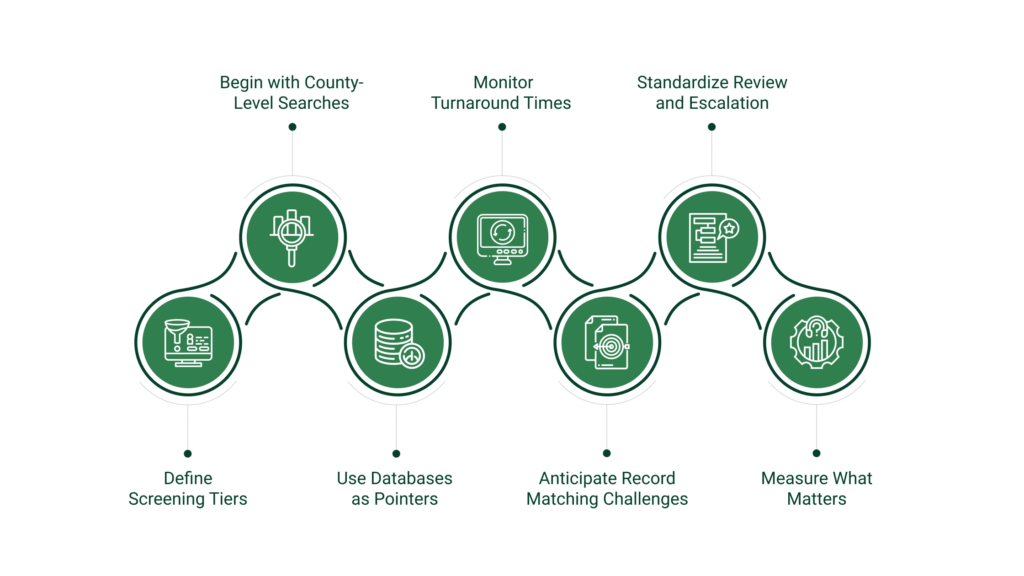
A county-first approach is not just about choosing the correct type of search. It is about establishing a structured process that strikes a balance between accuracy and efficiency, while ensuring repeatability across large volumes of cases.
Step 1: Define Screening Tiers
Not every case requires the same level of depth. By creating screening tiers, organizations ensure that resources are focused where they matter most. For example, standard roles or applicants might require county checks tied to residence and employment history. More sensitive roles or high-risk situations may trigger enhanced screening, which includes statewide or federal checks. Clear tiers maintain a lean process without sacrificing thoroughness in critical cases.
Step 2: Begin with County-Level Searches
Starting with county searches ensures that the foundation of the process is based on verified records. Counties provide the clearest view into charges, case progress, and outcomes. By anchoring decisions here, organizations reduce the risk of relying on outdated or incomplete information.
Step 3: Use Databases as Pointers
Databases can still add value when used properly. A multi-jurisdictional database might flag activity in a county that was not previously identified. Instead of treating that as a final result, the smarter approach is to use it as a pointer. Run a county search in the identified jurisdiction to confirm the details. This hybrid workflow utilizes the breadth of databases and the accuracy of county records, giving teams both coverage and confidence.
Step 4: Monitor Turnaround Times
Turnaround time is one of the main challenges with county searches. Some counties return results in hours, while others may take up to 10 business days or more. The difference often comes down to whether records are digitized or still require manual clerk assistance. Some courts require court runners to retrieve records in person.
Organizations that track average turnaround times by county can anticipate delays and plan accordingly. Building a “slow county” list ensures expectations are realistic and workflows are scheduled with accuracy in mind.
Step 5: Anticipate Record Matching Challenges
A growing operational hurdle in county-level screening is the redaction of date-of-birth data in some jurisdictions. This makes record matching more complex because the date of birth is often a critical identifier in confirming that a record belongs to the right individual. When this happens, additional matching criteria such as address history or case details must be used.
A smarter process accounts for these challenges upfront by creating clear protocols for handling cases where identifying information is limited. This reduces the risk of errors while maintaining workflow consistency.
Step 6: Standardize Review and Escalation
Consistency is crucial in effective screening. A standardized checklist for reviewing results ensures that nothing is overlooked and that records are interpreted consistently. Escalation steps should be defined in advance, identifying who reviews findings that require further consideration and how those findings are documented. Clear roles and responsibilities reduce confusion and keep the process moving forward.
Step 7: Measure What Matters
Building a smarter process requires ongoing evaluation. Useful metrics include time to decision, the percentage of database leads that verify at the county level, and the rate of last-minute reversals due to incomplete data. By tracking these measures, organizations can identify weaknesses and continuously refine their workflows.
Why County-First Saves Time in the Long Run?
It may seem counterintuitive to prioritize county searches when they sometimes take longer to return results than databases. But the time saved later in the process outweighs the initial investment.
Database hits often require county verification anyway. Starting at the county level eliminates duplicate steps and reduces the likelihood of false positives. Verified records also reduce the disputes and confusion that can slow down approvals. Finally, by tracking turnaround times and anticipating delays, organizations create more predictable workflows that keep projects and onboarding on schedule.
A county-first approach ultimately reduces wasted effort and builds confidence in every decision.
Best Practices for Smarter Screening
To put all of this together, here are the practices that make county-first screening sustainable and scalable:
- Define screening tiers and apply them consistently
- Always start with county-level checks in counties tied to residence, work, or study history
- Use databases only as resources to identify additional jurisdictions
- Track turnaround times closely and plan workflows around known delays
- Prepare for record-matching challenges such as date-of-birth redaction
- Standardize how results are reviewed, documented, and escalated
- Measure outcomes to refine the process over time
- Work with a provider that specializes in county searches to manage scale and complexity
Screen with Confidence and Clarity Through Verification Screening Solutions
County-level searches are the starting point for developing a more effective criminal screening process. Verification Screening Solutions (VSS) helps organizations put these best practices into action by combining targeted county checks with efficient workflows that minimize blind spots and delays.
Our services include:
Ready to start building a smarter screening process at the county level? Take the first step toward more accurate, efficient, and confident decisions.