
Making the right hiring decisions requires more than a quick look at a resume. Businesses need dependable information to reduce risk and protect workplace integrity, and county-level criminal searches are important in that process. These searches provide direct access to the courts where most criminal records originate, offering a level of detail and accuracy that broader databases often miss.
Recent data shows that 93% of employers conduct criminal background checks on all candidates as part of their hiring process. This widespread reliance reflects a growing need for precise, jurisdiction-level information, the kind that county searches provide.
As businesses evaluate the costs of conducting these checks, it’s equally important to understand the value they deliver. County-level criminal searches can help prevent costly hiring mistakes, improve workplace safety, and support sound decision-making across the organization. This blog discusses the real cost vs. value of these searches, helping you determine why they’re a smart investment for your hiring strategy.
What Are County-Level Criminal Searches?
County-level criminal searches review records directly at the county courts, where most criminal cases are filed and maintained. Because these courts are the original source of criminal information, the results offer clear, detailed insight into a candidate’s history within a specific jurisdiction.
These searches can provide:
- Charges filed at the county level
- Case numbers and filing dates
- Dispositions and sentencing information
- Pending cases and recent updates
- Misdemeanor and felony records based on county reporting
County-level searches give employers precise, jurisdiction-specific information that supports confident hiring decisions and reduces the risk of relying on incomplete or outdated data.
The Cost Side of County Criminal Searches
County-level criminal searches involve accessing records directly from local courts, and several variables influence the overall cost. Understanding these factors helps businesses plan their screening budgets more effectively.
Costs can vary based on:
- Number of counties searched: Candidates who have lived in multiple jurisdictions may require searches across several counties.
- Method of retrieval: Some county courts offer electronic access, while others require in-person, manual record pulls. Manual searches often take more time and incur higher court fees.
- Address history or aliases: Candidates who have lived in multiple jurisdictions may require searches in additional counties, which can affect turnaround time and cost.
As a general benchmark, basic online criminal checks may cost less than $50, but county-level searches often require deeper access and additional court fees. While these searches can be more costly than broad database checks, they deliver precise, court-sourced information that supports reliable hiring decisions.
Importance of County-Level Searches
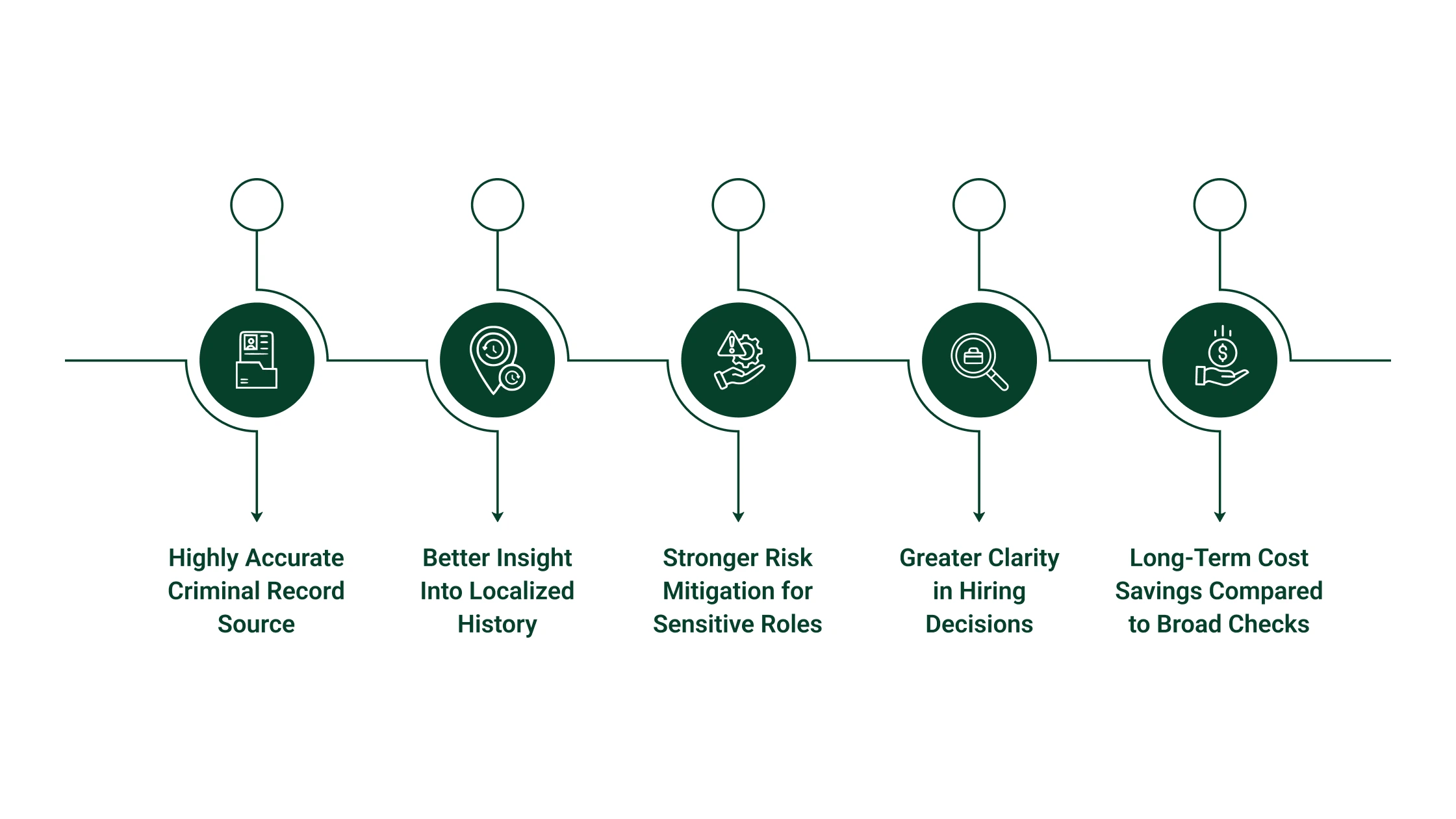
County-level criminal searches provide businesses with the most accurate and detailed view of a candidate’s criminal history, directly from the courts where cases originate. This level of clarity helps reduce hiring risks, protect workplace integrity, and support strong decision-making. When weighed against the potential cost of a bad hire, the value of precise, jurisdiction-level information becomes clear.
Highly Accurate Criminal Record Source
County-level criminal searches access records directly from the courts where cases are filed, processed, and updated. This makes them the most dependable source for detailed, jurisdiction-specific information. Businesses benefit from reviewing records exactly as they appear at the originating court, without delays or gaps that can occur in aggregated systems.
- Direct court access: Results come straight from the county court where the case was recorded, ensuring authenticity.
- Current record updates: County clerks update case statuses regularly, providing timely information.
- Detailed case information: Searches reveal specifics such as charges, dispositions, and filing dates.
- Jurisdiction-level precision: The results focus on the exact county connected to the candidate’s address history.
- Reduced risk of missing data: Local records often contain cases not yet reported to broader systems.
County-level searches give employers confidence that they are working with the most complete and accurate criminal record data available.
Better Insight Into Localized History
County-level criminal searches give employers a clear view into a candidate’s history within the specific communities where they lived, worked, or spent significant time. This level of detail is especially valuable because many cases handled at the county court may not appear in broader searches, making jurisdiction-specific records an important part of a thorough screening process.
- Community-specific information: These searches provide insight into cases recorded in the exact locations connected to a candidate’s past.
- Local court handling: Many cases involving misdemeanors or probation violations are maintained at the county court level, offering a more complete record than broader, aggregated sources.
- Clearer visibility into jurisdiction-level activity: County-level searches can show patterns of court-recorded activity within a specific area without interpreting or characterizing the candidate’s behavior.
- More context for review: Employers receive jurisdiction-specific information that helps support internal hiring processes without suggesting suitability decisions.
- Greater value for locally focused roles: Positions tied to particular communities benefit from the clarity that county-level records provide, especially when understanding a candidate’s history within those jurisdictions is important to the business.
Stronger Risk Mitigation for Sensitive Roles
County-level criminal searches offer detailed, court-sourced information that helps businesses maintain clarity during their internal hiring processes. Because these searches pull records directly from the courts, they provide jurisdiction-specific details that may not appear in broader, aggregated sources. This can be especially valuable for roles that involve added responsibility or require a dependable review process.
- Clear court information: Direct access to county records helps businesses see case details as maintained by the reporting court, including updates and outcomes.
- Consistent information flow: County searches offer dependable insight into the activity recorded at the local level, supporting screening practices that require a structured approach.
- Useful for roles with added responsibility: Businesses filling positions that involve oversight, access, or trust may find the additional clarity helpful when reviewing information relevant to the role.
- Supports internal hiring steps: Businesses can incorporate county-level results into their existing decision-making processes without interpreting suitability or providing legal assessment.
- Enhances overall process reliability: Accurate, court-sourced information helps reduce the uncertainty that sometimes comes from incomplete or outdated data.
Greater Clarity in Hiring Decisions
County-level criminal searches offer employers clearer, court-sourced information that supports internal hiring workflows. Because these searches access records directly from the originating county court, they help reduce uncertainty that may come from incomplete or outdated information.
- Verified court information: County-level records allow businesses to review details exactly as they appear at the reporting court.
- Clear case outcomes: Access to filings, updates, and dispositions helps provide a complete picture of the case information available at the county level.
- Consistent information for internal processes: Businesses can incorporate accurate, jurisdiction-specific results into their existing review procedures without interpreting suitability or assessing candidate qualification.
- Supports structured decision-making: Reliable court data allows teams to follow their internal steps with more confidence in the completeness of the information being reviewed.
- Reduces follow-up research: Clear, updated records can minimize the need for additional clarification when businesses are gathering information for their hiring process.
Long-Term Cost Savings Compared to Broad Checks
County-level criminal searches may involve a higher initial cost than broader, non–court-sourced options, but they often provide longer-term advantages related to information quality and completeness. Accessing records directly from the county courts helps ensure businesses receive accurate and up-to-date information that supports consistent internal hiring practices.
- Fewer follow-up steps: Accurate court-sourced results reduce the need for additional searches when information from aggregated sources is incomplete or outdated.
- Greater clarity during reviews: Clear record details can help streamline internal processes by reducing uncertainty around case information.
- Reduced duplicative screening: Comprehensive county data can limit the need to re-run checks to confirm details that may not appear in non–court-sourced systems.
- Helps maintain internal workflow stability: Having precise, regularly updated case information supports smoother hiring workflows and reduces delays that can occur when information must be re-verified.
- Supports long-term process efficiency: When businesses rely on consistent, jurisdiction-level results, they are better able to maintain predictable screening timelines and manage costs across multiple roles.
By prioritizing accuracy at the county level, businesses invest in screening that supports stronger, more cost-effective hiring outcomes.
Assessing Cost vs. Value: Major Business Considerations
Determining how county-level criminal searches fit into a company’s screening approach involves reviewing both budget requirements and the level of detail needed for internal hiring processes. Because county searches offer court-sourced information, they can provide helpful clarity when businesses need jurisdiction-specific records.
- Review jurisdictions connected to the candidate: Candidates who have lived in multiple counties may require searches across several locations to ensure relevant court records are included.
- Use screening services together effectively: SSN Trace and Multi-State Criminal Search can help identify counties connected to a candidate’s history before initiating county-level searches, allowing businesses to focus on the jurisdictions most relevant to their review.
- Balance cost with information needs: County-level searches may carry added fees in some jurisdictions, so businesses can determine how these costs align with the level of detail they want for their internal processes.
- Target relevant counties: Focusing on counties tied to the candidate’s activity helps ensure searches remain both accurate and cost-efficient.
- Maintain consistency across roles: Businesses may choose to apply different screening levels depending on their internal hiring policies, ensuring the process remains aligned with organizational requirements.
Best Practices to Maximize Value and Control Cost
Maximizing the value of county-level criminal searches begins with identifying the jurisdictions most relevant to a candidate’s history. A focused approach helps ensure businesses receive accurate, court-sourced information while managing screening expenses effectively.
- Prioritize relevant counties: Businesses can review counties tied to a candidate’s recent activity to ensure searches concentrate on the most applicable locations.
- Use SSN Trace to guide jurisdiction selection: This service helps identify counties associated with a candidate’s address history, allowing organizations to direct county-level searches where they will be most meaningful.
- Combine services efficiently: Pairing county searches with other available screening options, such as Multi-State Criminal Search, supports a more complete view before initiating jurisdiction-specific checks.
- Align screening steps with internal policies: Companies can determine how county-level searches fit into their established hiring processes, ensuring consistency across various positions.
- Maintain awareness of fee structures: Because some counties charge additional court fees, businesses can review these costs in advance to plan effectively and manage budgets.
By applying these best practices, businesses can enhance their hiring accuracy, reduce unnecessary costs, and ensure a more streamlined and effective county-level screening process.
Support Your Hiring Goals with Proven Screening Services from Verification Screening Solutions

County-level criminal searches offer clear, court-sourced information that helps businesses access accurate and jurisdiction-specific records. When incorporated into established hiring processes, they can support consistent and well-structured internal reviews.
Verification Screening Solutions provides dependable screening services tailored to your business needs, including: