
Driving responsibilities do not remain static after an employee is hired. License status, recorded driving history, and other state-maintained records can change over time, particularly for employees whose roles involve regular travel or vehicle operation. Understanding how driving activity intersects with everyday work begins by examining broader roadway data.
According to the National Safety Council, the motor vehicle death rate was 1.15 deaths per 100 million vehicle miles traveled, based on recent preliminary estimates. This figure shows how frequently serious incidents occur relative to the amount of driving, and highlights why driving history remains a relevant data point over time.
For organizations that rely on employees to operate vehicles as part of their role, this context underscores the value of ongoing awareness of state-recorded driving information rather than relying solely on a one-time review at hire. An annual Motor Vehicle Report (MVR) screening approach offers a structured way to revisit driving records as part of internal planning.
In this blog, we’ll discuss the general considerations for setting up an annual MVR screening approach, focusing on identifying applicable roles, determining review timing, and maintaining consistency across internal processes without interpretation, judgment, or regulatory guidance.
Identifying Roles That May Require Annual MVR Reviews
An annual Motor Vehicle Report screening approach begins with identifying which employee roles involve driving as part of regular work activities. Not every position requires the same level of review, so organizations often start by looking at how frequently and consistently vehicles are used in day-to-day operations.
Roles commonly considered for annual MVR reviews include positions where employees operate company vehicles, drive between job sites, or travel extensively as part of their responsibilities. This may involve delivery personnel, service technicians, field sales teams, fleet drivers, or employees who regularly transport equipment or materials. In these cases, driving is not incidental but connected to how the role functions.
Some organizations also include roles where driving occurs less frequently but remains a recurring responsibility throughout the year. The goal is not to categorize roles by risk, but to clarify where driving activity is part of the job. Clearly defining these roles helps businesses maintain consistency in their internal processes and ensures that annual MVR reviews are applied in a structured, predictable way.
Factors to Consider When Planning Annual Screening
Unwanted driving behaviors that are represented in MVRs can be caused by a variety of life events, including the death of loved ones, divorce, illness, and other issues that lead to alcohol or drug abuse. A driver might be able to conceal these actions from their employer in some circumstances. One of the main advantages of a robust MVR review program is obtaining this information through annual MVR checks prior to a serious accident or other incident.
When setting up an annual Motor Vehicle Report screening approach, organizations often focus on creating a process that is clear, repeatable, and easy to manage. While the structure may vary by company, several common planning considerations tend to shape how annual reviews are organized.
Major factors organizations often consider include:
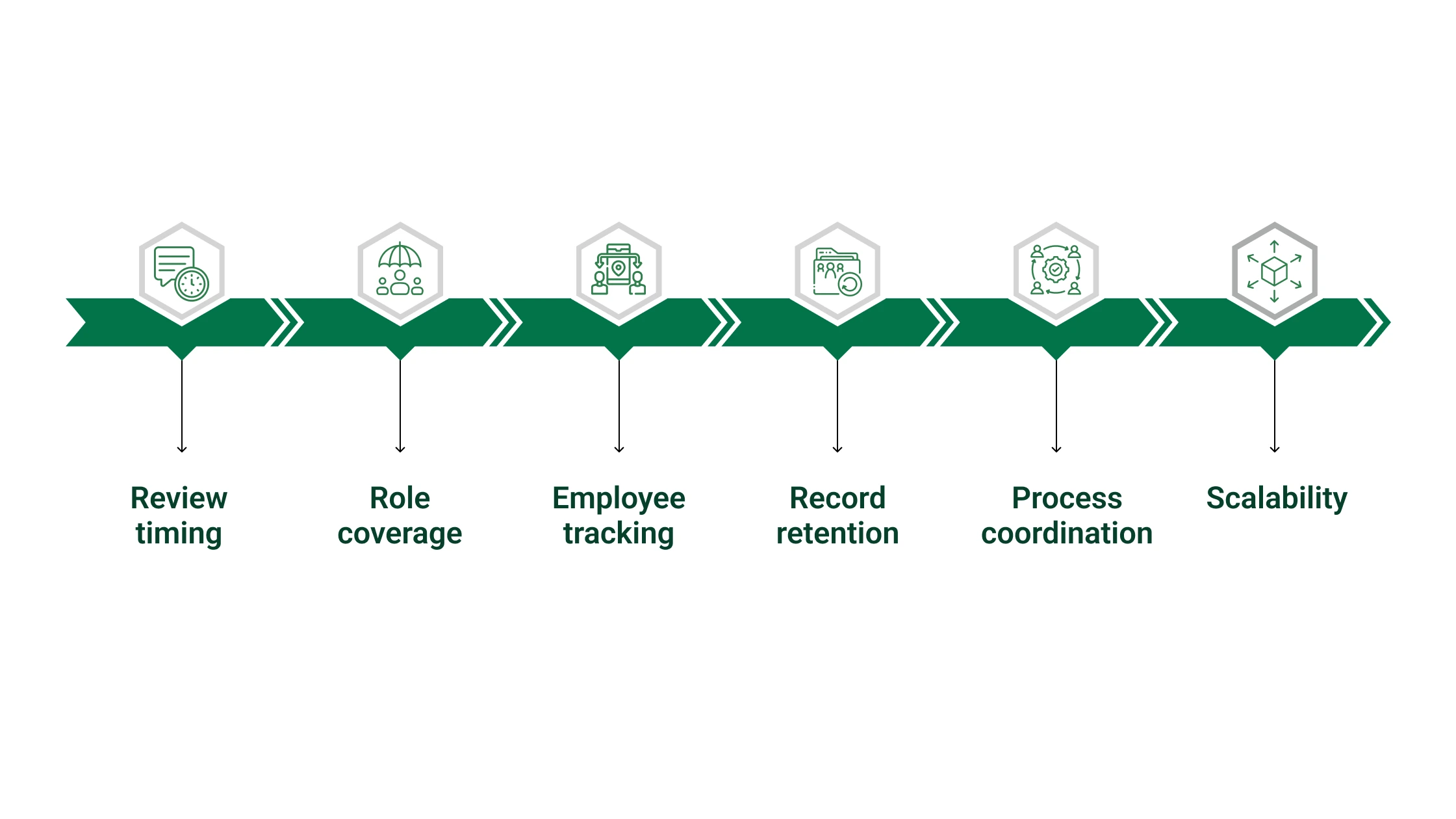
- Review timing: Selecting a consistent schedule, such as aligning MVR reviews with annual cycles or internal review periods, helps ensure records are revisited regularly.
- Role coverage: Defining which driving roles are included in the annual process helps maintain clarity and avoid inconsistent application across teams.
- Employee tracking: Keeping an updated list of employees subject to annual MVR reviews helps organize records and prevent missed or duplicate checks.
- Record retention: Storing previous MVR results in a consistent format allows teams to reference historical information during each annual review.
- Process coordination: Aligning annual MVR reviews with other internal screening activities helps maintain smoother workflows without introducing additional complexity.
- Scalability: Considering how the process will function as teams grow or change helps ensure the annual approach remains manageable over time.
Focusing on these elements allows organizations to plan annual MVR screening in a way that supports internal awareness and consistency, without interpreting outcomes or setting prescriptive rules.
How to Establish Consistent Internal Procedures
An annual Motor Vehicle Report screening approach is most effective when it follows a clearly defined and repeatable internal workflow for post-hire verification. Documenting each step of the process helps ensure that MVR reviews are conducted the same way each year, regardless of who initiates the request or where the employee is located. Clear documentation also supports continuity when responsibilities shift between teams or personnel.
Consistency becomes especially important for organizations operating across multiple sites or business units. Without a uniform approach, MVR data may be requested, reviewed, or stored differently from one location to another. This can lead to uneven record handling and confusion when information needs to be referenced later. Applying the same procedures across all locations helps maintain comparable records and simplifies internal coordination.
The focus of a documented workflow is administrative clarity, not interpretation. Establishing when MVRs are requested, how results are recorded, and where documentation is maintained allows teams to follow a predictable process. This supports internal alignment and helps organizations manage annual reviews in a structured, organized manner without assessing outcomes or making suitability determinations.
How to Communicate the Policy Internally

Once an annual Motor Vehicle Report screening approach is established, clear internal communication helps ensure the process is understood and applied consistently. Communication is not about enforcing rules or interpreting outcomes, but about making teams aware that annual MVR reviews are part of standard internal procedures for roles that involve driving.
When expectations are clearly documented and shared, organizations reduce confusion and support smoother administrative handling across departments .
Document Policy in Handbooks
Many organizations choose to document annual MVR screening within employee handbooks, onboarding materials, or internal policy resources. Including a brief explanation of when and why MVR reviews occur helps employees understand how driving-related records fit into broader internal processes. This approach creates a consistent reference point that teams can revisit as needed.
Standardize Internal Review Guidelines
Clear internal guidelines help hiring managers, operations teams, and administrative staff understand their role in the annual MVR review process. Outlining responsibilities, timelines, and documentation steps in a shared internal guide supports consistency and reduces variations in how reviews are handled across teams or locations.
Reinforce Awareness With Reminders
Some organizations reinforce awareness through periodic reminders, such as internal emails or scheduled notifications tied to review cycles. These reminders help keep annual MVR screening visible as a routine process, ensuring teams remember upcoming reviews without relying on informal or ad hoc communication.
How to Keep Records Organized for Annual Review
An annual Motor Vehicle Report screening approach works best when records are easy to locate, consistently stored, and clearly documented. Organized record-keeping supports smoother internal processes and helps teams understand what information has already been reviewed during prior cycles.
Many organizations choose to maintain a centralized repository for MVR results tied to employees with driving responsibilities. Storing reports in a consistent format makes it easier to track when reviews occurred and when the next annual check is due. Clear file naming conventions and standard documentation practices also reduce confusion, especially when multiple teams or locations access the same records.
Tracking historical MVR results year over year helps administrative teams maintain continuity without having to repeatedly review the same information. The focus remains on administrative clarity rather than on evaluation, supporting a predictable, structured annual review process.
This approach helps organizations:
- Maintain visibility into prior review dates and documentation
- Reduce duplicate record requests or unnecessary rechecks
- Support consistent handling of driving-related records across roles
- Preserve internal transparency across teams and locations
Support Annual Driver Screening With Motor Vehicle Reports From Verification Screening Solutions
Setting up an annual Motor Vehicle Report screening approach helps organizations maintain ongoing awareness of state-recorded driving information for employees whose roles involve vehicle use.
By identifying applicable roles, planning review timing, documenting repeatable procedures, and communicating clearly across teams, businesses can manage annual reviews consistently and in an organized way. The focus remains on clarity and internal alignment rather than interpretation or outcome assessment.
Verification Screening Solutions supports employers with background screening services, including:
Learn more about Motor Vehicle Reports or to discuss how annual MVR screening can fit into your existing internal processes.