
U.S. staffing companies hire 12.7 million temporary and contract employees each year. From warehouses to corporate offices, contingent workers fill critical roles across industries.
But with this growing reliance on temporary staff comes an important consideration: how can businesses make informed hiring decisions while keeping up with operational demands? Temporary and contract roles often follow faster hiring timelines, which may lead to varied screening protocols, making it important for businesses to carefully evaluate how they manage workforce integrity and operational risk.
A uniform background search process may not address the varying needs of contingent roles. Role-specific background search components can help align the screening process with job requirements while maintaining efficiency, safety, and accuracy.
Why Does Background Screening Matter for Temporary & Contract Employees?

Temporary and contract employees may not have long-term tenure, but their impact on a workplace can be just as significant as that of full-time staff. When contingent roles involve access to sensitive data, customer interactions, or higher-risk environments, background screening can help employers make informed decisions that support workplace integrity and safety.
1. Protecting Workplace Safety
Safety is a critical consideration when hiring for any role. In temporary or contract positions, where hiring timelines are often condensed, overlooking or rushing the screening process may increase workforce-related risks. Background screening supports safer hiring by providing objective, reportable data that employers can use to make informed decisions.
2. Preventing Fraud, Theft, and Misconduct
Fraud and internal misconduct can impact organizations of any size. In contingent roles that involve access to financial systems, sensitive data, or company assets, employers often face elevated exposure to operational risk. Background screening provides verified, reportable information that can help employers make more informed hiring decisions based on documented history.
3. Compliance Alignment with Industry Expectations
Many industries—including healthcare, finance, and transportation—require employers to meet specific hiring standards for all workers, including temporary and contract personnel. While regulatory requirements vary, background screening provides employers with documented information they may use to help support internal compliance practices and industry-specific protocols.
4. Avoiding Costly Turnover & Rehiring
Temporary roles are often filled under tight deadlines, which can compress the screening timeline. If key verifications are overlooked, employers may face increased administrative burden from early departures, retraining, or repeat hiring. Background screening helps support more efficient hiring decisions by providing verified information before onboarding begins.
5. Protecting Brand Reputation
Every hiring decision contributes to a company’s overall culture, reliability, and public perception. In temporary or contract roles, where onboarding may move quickly, background screening provides documented information that helps employers make informed decisions aligned with their internal policies and expectations, supporting workforce integrity and operational consistency.
Adapting Screening Practices to Support Contingent Hiring Needs
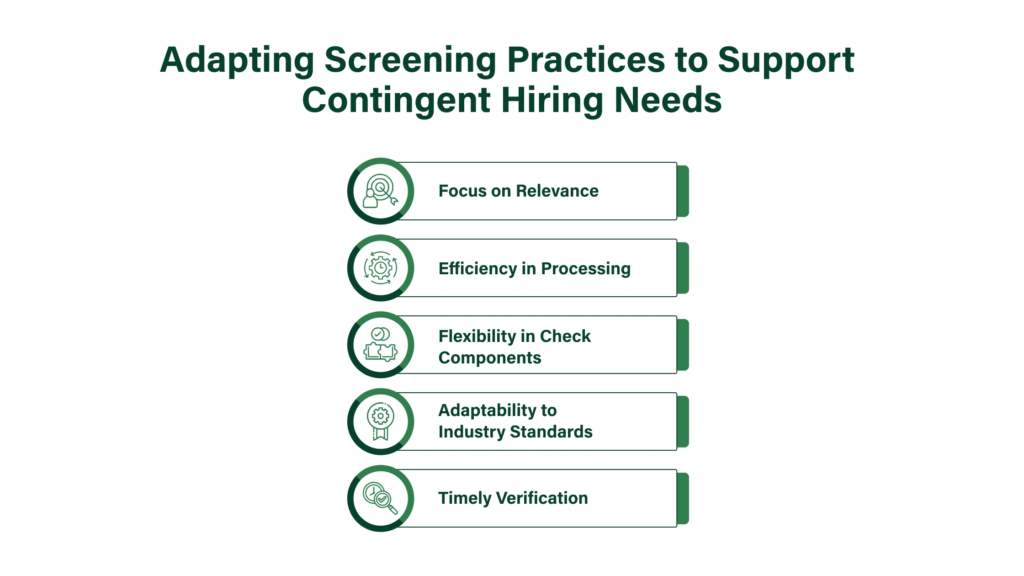
The hiring process for temporary and contract roles often moves faster than traditional full-time recruitment, presenting unique challenges for employers. While speed is often a priority, it’s equally important to maintain consistency, accuracy, and alignment with internal policies and regulatory expectations.
In this section, we explore key considerations that can help employers structure screening practices to meet the specific demands of contingent hiring, without compromising reliability or compliance.
1. Focus on Relevance
Screening needs can vary depending on the responsibilities, access levels, and risk exposure of each role. Applying the same screening process across all contingent positions may increase time-to-hire and operational costs without improving outcomes. Employers often select screening components that reflect the scope of each job.
For instance:
- Roles involving physical access to warehouses or equipment may prompt screening for prior criminal records or other employer-managed safety checks.
- Positions that handle sensitive financial data may prompt employers to include employment verification or civil court searches, depending on their internal screening policies.
- In healthcare roles, some employers may conduct internal license checks or registry lookups based on their organizational policies or industry-specific requirements.
Adapting screening practices to reflect job responsibilities allows employers to maintain efficiency while supporting safety, consistency, and regulatory alignment.
2. Efficiency in Processing
Temporary and contract roles are often time-sensitive, with hiring decisions made quickly to meet seasonal peaks or project deadlines. While speed is important, screening steps should still be managed with care to help support consistency, compliance, and candidate evaluation.
To streamline the process, many employers:
- Leverage technology tools that enable faster access to background screening data, such as secure intake links for entering applicant information or pre-configured workflows.
- Prioritize screening components most relevant to the role before expanding to additional verifications.
- Align with staffing partners in advance by setting clear screening expectations and turnaround timelines.
With the right systems in place, employers can reduce delays while continuing to uphold internal standards for safety and process integrity.
3. Flexibility in Check Components
Screening approaches for temporary and contract roles often vary depending on the responsibilities, access level, and operational risk associated with the position. Applying the same depth of screening across all contingent roles may extend timelines or increase cost without improving decision quality.
To manage this, many employers adjust screening components based on internal protocols or the nature of the role:
- Positions with limited access or short-term assignments may involve select criminal record searches or other limited screening steps, depending on internal policy.
- Roles that involve equipment operation, driving, or financial handling may prompt employers to include employment verification or motor vehicle records (MVR), depending on internal risk policies.
- Higher-trust roles—such as those involving patient care, sensitive data, or regulatory oversight—may require additional verification steps based on industry requirements.
Some organizations that re-engage temporary workers regularly may also implement internal re-verification procedures, focusing on new or updated information rather than repeating every check. These adjustments can help improve efficiency while supporting internal consistency and compliance practices.
4. Adaptability to Industry Standards
Industry-specific regulations often influence how employers structure their background screening practices, particularly in sectors where safety, licensing, or financial access is involved. When hiring temporary or contract workers, employers may need to align their internal screening policies with applicable mandates or industry protocols.
Examples of industry-specific screening considerations include:
- Healthcare & Pharmaceuticals – Employers in this space may follow internal screening procedures that include role-based criminal searches and other checks required by their regulatory protocols.
- Finance & Accounting – Employers may include employment verifications as part of their internal screening processes, particularly for roles involving financial access or oversight.
- Transportation & Logistics – Screening may include Motor Vehicle Records (MVR) searches, DOT compliance checks, or substance testing.
- Education & Childcare – Employers may include sex offender registry searches, education verification, and criminal record searches depending on role requirements.
5. Timely Verification
Temporary and contract roles are often filled under tight timelines, especially in industries where staffing needs arise quickly. While speed is critical, screening steps must still be managed carefully to avoid delays and ensure consistent hiring practices. A thoughtful process that balances timing with data accuracy can help support more reliable onboarding outcomes.
Common employer strategies to improve turnaround time include:
- Pre-Screening Candidates in Advance – Maintaining a pool of pre-vetted candidates can help employers re-engage workers quickly without reinitiating the full screening process.
- Using Technology for Faster Access – Screening providers may offer secure methods for entering applicant information, such as employer or applicant-facing system links to help streamline the process. These tools can reduce administrative steps and support faster turnaround times.
- Sequencing Screening Components – Employers may begin with faster-return verifications (e.g., criminal record searches) and follow with additional components based on the role.
- Aligning With Trusted Screening Providers – Working with a screening partner that offers efficient access to verified data and transparent timelines can improve overall speed without sacrificing accuracy.
A process that supports both speed and consistency allows employers to stay responsive to staffing needs while maintaining internal standards across contingent hiring.
Essential Background Checks for Temporary & Contract Employees
The screening needs for temporary and contract workers often vary by role, industry, and internal company policies. While requirements may differ, many employers choose to include specific background screening services that align with the responsibilities of the position and support workplace consistency, risk awareness, and informed hiring decisions.
Employers often select screening components based on the responsibilities, risk exposure, and internal policies tied to each temporary or contract role. Commonly used services may include:
✔ County-Level Criminal Search – Provides access to criminal case records at the county level, often used to support role-based risk awareness.
✔ Statewide Criminal Search – Pulls from state repositories to offer broader insight into records reported across multiple counties (not all states offer statewide criminal searches).
✔ Federal Criminal Search – Covers violations adjudicated in federal courts, including offenses handled through the U.S. District Court system.
✔ Multi-State Criminal Search – Aggregates data from multiple sources to help employers identify potential records in jurisdictions not initially requested.
✔ SSN Trace – Reveals associated names and address history tied to a provided Social Security Number, supporting jurisdiction selection for further searches.
✔ Employment Verification – Confirms employment history based on employer-provided information, helping support alignment with stated work experience.
✔ Education Verification – Validates academic credentials earned by the applicant, as reported by verified institutions.
✔ Motor Vehicle Report (MVR) – Provides driving history data, often used when driving is part of the role’s responsibilities.
✔ Sex Offender Registry Search – Searches state and national databases to identify registration records where permitted by law.
✔ County-Level Civil Search – Provides access to civil court filings at the county level, allowing employers to review available public records based on their internal screening policies.
✔ Federal Civil Search – Identifies civil cases filed in U.S. District Courts, typically involving federal regulatory or financial matters.
✔ Fingerprinting – Used in scenarios where regulatory frameworks or employer policy require biometric-based identification and state or federal reporting.
Support Smarter Hiring Decisions for Temporary & Contract Workers
Building a consistent screening process for temporary and contract workers doesn’t have to be complicated. At Verification Screening Solutions, we deliver fast, reliable, and customizable background screening services aligned with your hiring needs. Whether filling short-term roles or managing a large contingent workforce, our reports are designed to help support informed hiring decisions while meeting internal standards and regulatory expectations.
Don’t leave your screening process to chance—work with a provider that understands the demands of contingent hiring.
Our services include:
- County-Level Criminal Search
- Statewide Criminal Search
- Federal Criminal Search
- Multi-State Criminal Search
- Motor Vehicle Report (MVR)
- Sex Offender Search
- Federal Civil Search
- County-Level Civil Search
- SSN Trace
- Employment Verification
- Education Verification
- Fingerprinting
Learn how to streamline your background screening process.