
Hiring at scale requires balance. On one side is the urgency to fill roles quickly to keep operations moving; on the other is the obligation to conduct thorough county-level criminal background checks. These checks are considered the gold standard of accuracy because they draw from the most direct legal source: the county courthouse. Yet their thoroughness comes at a cost of time.
In high-volume hiring environments, even a short delay compounds. Each day a position remains unfilled can ripple through project schedules, service delivery, and team morale. At the same time, skipping steps or relying on incomplete databases exposes employers to compliance risks and potential liability.
In this blog, we will discuss the most common bottlenecks that slow county-level background checks and the proven strategies to streamline the process without sacrificing accuracy or compliance.
What Are County Criminal Background Checks and Why They Matter?
A county criminal background check is one of the most reliable ways to verify a candidate’s criminal history. These checks pull records directly from county courthouses, the very source where charges, convictions, and dispositions are first recorded. Since many crimes are prosecuted at the county level, this check provides the most up-to-date and accurate information about a candidate’s criminal record.
County checks typically cover details such as:
- Felony and misdemeanor charges
- Pending cases
- Sentencing information
- Case dispositions (dismissed, acquitted, or convicted)
They are important for employers because they help mitigate risk, ensure compliance with regulatory requirements, and protect workplace safety. In industries like healthcare, education, finance, and transportation, where compliance and public trust are paramount, skipping county-level checks could expose businesses to liability and reputational damage.
Speed matters too. In high-volume hiring, even a few days of delay can slow down onboarding, frustrate hiring managers, and potentially cause companies to lose qualified candidates to competitors. Balancing thoroughness with efficiency is why streamlining county-level checks is now a strategic priority for HR leaders.
Common Challenges in County Criminal Background Checks
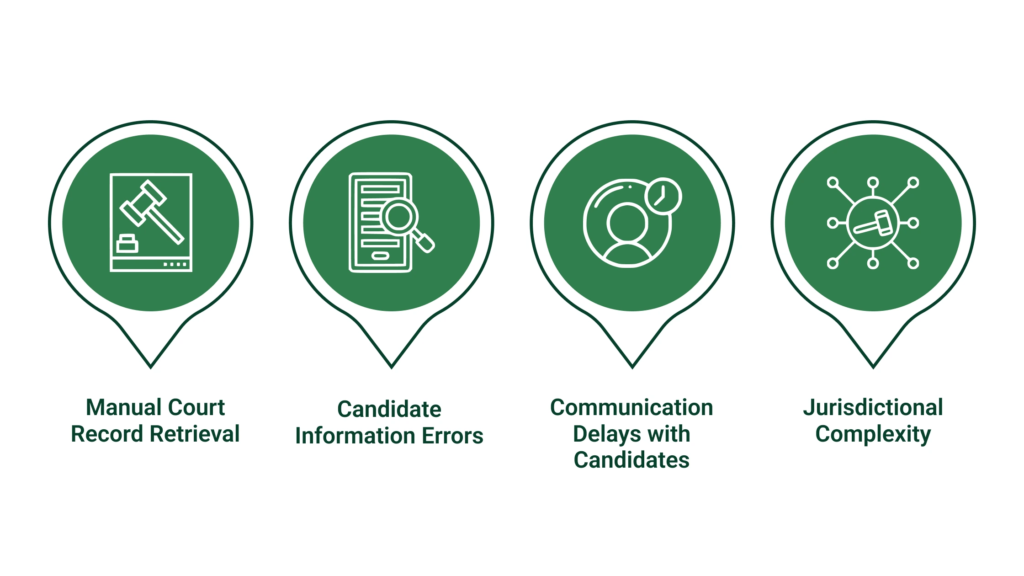
Even though county-level criminal checks are highly accurate, the process isn’t always smooth. In high-volume hiring, even minor delays can impact overall time-to-hire. Several common bottlenecks slow down turnaround times and frustrate both employers and candidates.
Manual Court Record Retrieval
Many county courts still rely on manual processes rather than digitized records. This means clerks or researchers must physically search courthouse files to locate criminal records. Turnaround time can vary widely by jurisdiction; some counties process requests within hours, while others take several days or more.
For employers managing hundreds of hires, waiting for manual searches adds uncertainty and can derail hiring schedules. The lack of consistent record accessibility across counties is one of the most significant contributors to delays in background checks, making it harder for organizations to standardize timelines.
Candidate Information Errors
Background checks are only as accurate as the data submitted. When candidates mistype personal information, searches may fail or return incomplete results. These discrepancies often require manual intervention, re-verification, and resubmission, all of which add time.
Some of the most common errors include:
- Misspelled names: Even a minor typo can cause mismatches in county court databases.
- Incorrect dates of birth: A single digit off can flag the wrong record or return no match at all.
- Missing Social Security numbers: Incomplete identifiers reduce the accuracy of record searches.
- Unreported aliases or name changes: Married names, nicknames, or prior legal names may be omitted.
- Incomplete address history: Leaving out counties of residence creates blind spots in searches.
In large-scale hiring, even a small percentage of these errors can create backlogs for HR teams. Employers can mitigate this by using digital data collection resources with built-in validation features to minimize entry mistakes and flag missing fields before submission.
Communication Delays with Candidates
Employers must collect sensitive information from candidates before running county-level background checks. This includes identifiers like Social Security number and date of birth. If a candidate is slow to respond or misses a request for information, the entire process stalls.
In high-volume hiring, these lags multiply across applicant pools and can significantly extend time-to-hire. Clear communication, automated reminders, and mobile-friendly forms can help speed up response times while improving the candidate experience.
Jurisdictional Complexity
County-level criminal background checks can quickly become complicated when candidates have lived, worked, or studied in multiple jurisdictions. Each county maintains its own court records, databases, and processes, which means a single candidate may require searches across several locations. This creates logistical challenges for HR teams managing high-volume hiring.
Some of the most common jurisdictional issues include:
- Multiple counties of residence: Candidates who move frequently may require checks across multiple counties.
- Different record-keeping systems: Some counties maintain digital databases while others still rely on manual court clerks.
- Inconsistent reporting timelines: Case updates may be delayed in certain counties, creating information gaps.
- Varying access rules and fees: Costs and turnaround times differ by jurisdiction, adding administrative burden.
- Overlapping jurisdictional records: Some cases may be filed in multiple courts, requiring verification to avoid duplication.
For employers, these complexities can increase turnaround times and raise costs. Partnering with a background screening provider that has nationwide coverage and direct county court access helps reduce delays and ensure accurate, compliant results.
Strategies to Speed Up High-Volume County Checks
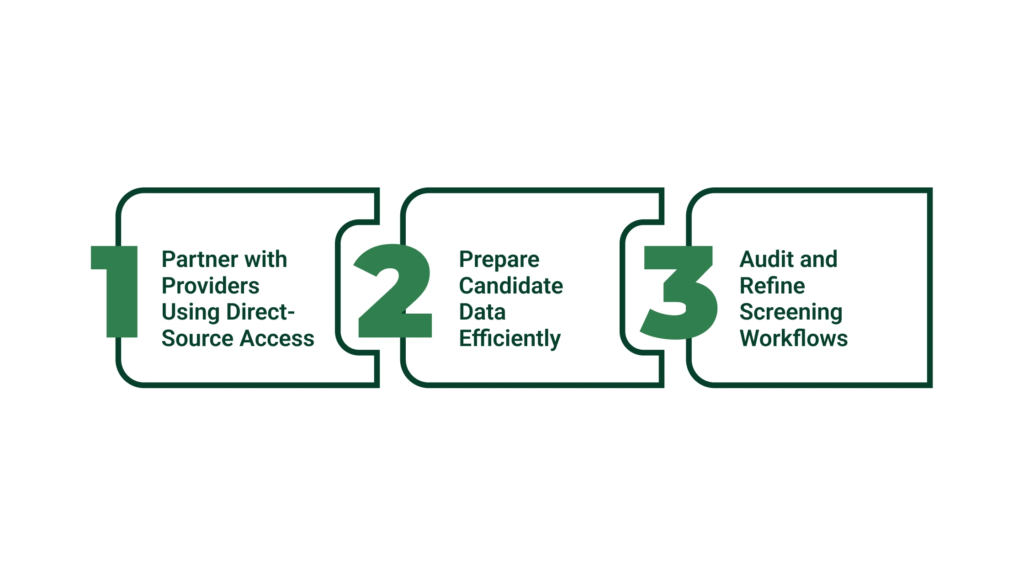
Hiring at scale requires background checks that move as quickly as your recruiting pipeline. Delays at the county level can slow down onboarding and frustrate both candidates and hiring teams. By adopting the right methods, workflows, and partnerships, employers can significantly reduce turnaround times while maintaining compliance and accuracy.
1. Partner with Providers Using Direct-Source Access
One of the most effective ways to streamline county-level criminal background checks is to work with screening providers that maintain direct-source access to county court systems.
Instead of relying on third-party intermediaries or outdated manual retrieval processes, direct-source access allows providers to pull records straight from official county databases. This reduces lag time, minimizes transcription errors, and delivers more reliable data.
For organizations managing high-volume hiring, these partnerships can mean faster turnaround times and fewer re-checks. Employers should ask providers about their network coverage, technology integrations, and compliance safeguards to ensure county checks are efficient and legally sound.
2. Prepare Candidate Data Efficiently
Delays in county-level background checks often stem from incomplete or poorly formatted candidate information. Employers that take time to organize and standardize data before submission help ensure smoother verification and minimize rework. Building accuracy into the process up front reduces errors and avoids backlogs in high-volume hiring.
Best practices include:
- Use standardized data collection methods: Collect candidate details in a consistent format to prevent mismatches across jurisdictions.
- Require essential identifiers: Full legal name, date of birth, and Social Security number should be mandatory to reduce gaps in records.
- Confirm address history: Review past residences to ensure all relevant counties are included in the search.
- Provide clear instructions to candidates: Guidance on how to enter information correctly can eliminate avoidable errors.
By emphasizing accuracy, employers accelerate turnaround times and reduce administrative friction, an advantage that becomes especially critical when hiring at scale.
3. Audit and Refine Screening Workflows
Even the most advanced software can’t compensate for an inefficient process. Regularly auditing your background check workflows ensures every step adds value rather than delay. HR leaders should review turnaround times, error rates, and vendor performance to identify hidden bottlenecks. By mapping out each stage, from candidate data intake to county record retrieval, you can pinpoint areas where automation, vendor updates, or policy adjustments will shorten timelines.
Routine refinements might include removing redundant verification steps, updating candidate communication templates, or consolidating vendor touchpoints. A quarterly review of metrics such as average processing time and percentage of flagged records keeps hiring teams proactive. Continuous improvement not only speeds up county-level checks but also aligns screening practices with evolving compliance standards.
Take the Complexity Out of County Checks with Verification Screening Solutions
Hiring at scale doesn’t have to mean trading speed for thoroughness. With the right strategies and partners, county checks can move as quickly as your hiring needs demand.
Verification Screening Solutions helps organizations accelerate county-level criminal background checks without compromising quality. Our screening solutions are built for speed, accuracy, and scalability, making high-volume hiring more manageable for your team.
VSS offers a full range of employment screening services, including:
- County-Level Criminal Searches
- Education Verification
- Employment Verification
- County-Level Civil Searches
- Federal Civil Search
- Federal Criminal Search
- Statewide Criminal Search
- SSN Trace
- Sex Offender
- Multi-State Criminal Search
- Motor Vehicle Report (MVR)
- Fingerprinting
Ready to simplify your background check process? Connect with VSS today and see how we can streamline county-level screenings for your organization.