
What if you hire someone based on a clean background check, only to discover weeks later that a recent conviction never appeared in the report? It happens more often than you think.
More than 25% of currently employed adults have at least one prior criminal conviction, yet many of those records remain buried in county court systems. National and statewide checks sound comprehensive, but they often miss the most recent or locally filed cases.
This gap creates a false sense of security. Employers assume they’ve done their due diligence, but without county-level searches, they’re making hiring decisions with incomplete information and exposing their business to risks they can’t see coming.
In this blog, we’ll discuss what gets missed when county-level searches are excluded and why those blind spots can cost far more than the time saved by skipping them.
Why Broader Background Checks Fall Short?
National and statewide databases are often marketed as all-in-one solutions, but their reach is limited. These databases are built from records supplied by counties and states, and the reporting process is far from uniform. Some counties update records daily, while others may delay updates for weeks or choose not to share certain records at all.
This inconsistency means that recent charges, misdemeanors, or even finalized cases can remain invisible to national searches for months. Employers who rely only on these sources are left with a partial snapshot of a candidate’s history.
Another issue lies in the quality of the data. Aggregated databases often lack critical details such as case outcomes, sentencing information, or the context needed to interpret a record correctly. A charge that was dismissed may still appear as pending, leading to confusion or unnecessary delays.
In short, broader checks provide reach, but not depth. Without county-level searches, employers risk missing the very details that matter most when evaluating a candidate’s background.
What Employers Miss Without County-Level Searches?
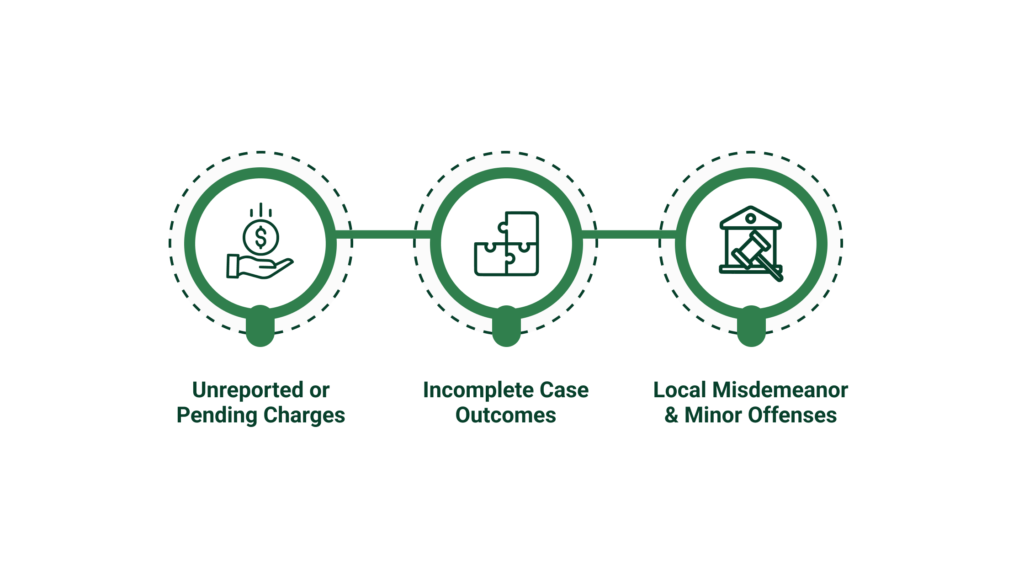
A background check is only as reliable as the data it is based on. When county-level searches are left out, employers often make decisions based on incomplete information, believing they have the complete picture when they don’t.
Local court records often contain details that are not included in national or state databases. Recent charges, case updates, or misdemeanor offenses can remain hidden for months or indefinitely, if the search doesn’t go directly to the source.
This gap means businesses may overlook essential facts about a candidate’s history, creating avoidable risks that surface only after hiring.
1. Unreported or Pending Charges
National and state databases are built from data submitted by counties, but this process isn’t always immediate or complete. New cases are often filed and remain visible only at the local courthouse long before they’re shared with broader systems. Without county-level searches, employers risk missing the most recent and relevant information.
- Delayed reporting: Some counties update records weekly or monthly, leaving a window where charges go unreported in national databases.
- Pending cases: Arrests and charges under review may not appear in aggregated systems until a case is finalized.
- Missed context: County records often include critical case details, such as specific charges, that broader checks summarize or omit entirely.
- Higher risk for high-turnover roles: Fast-paced hiring can lead to onboarding candidates before recent offenses appear in larger databases.
This lack of visibility can lead to a false sense of security, with hiring decisions being made before the most up-to-date information is available.
2. Incomplete Case Outcomes
Broad background checks often provide a fragmented view of a case. A charge may appear in a national database, but the outcome, whether it was dismissed, reduced, or led to sentencing, may not be recorded or updated promptly. This lack of context makes it difficult for employers to interpret the actual relevance of a record.
- Dismissed or dropped charges might still appear as active cases, leading to confusion or unnecessary delays.
- Reduced or amended charges may not be updated across all databases, resulting in outdated or inaccurate records.
- Sentencing details, such as probation, fines, or time served, are often missing in broader systems.
- Incomplete timelines can make it hard to determine how long ago the offense occurred or whether it has been resolved.
Without county-level searches, employers are left to make decisions based on summaries that lack crucial details about the case’s resolution.
3. Local Misdemeanor & Minor Offenses
Many offenses highly relevant to specific roles, such as theft, harassment, or disorderly conduct, are classified as misdemeanors and are handled exclusively at the county level. These cases often never reach national or state databases, leaving a blind spot in broader background checks.
- High relevance to trust-based roles: Minor theft or property damage offenses can impact positions involving cash handling, customer service, or inventory management.
- Recent or recurring patterns: A series of small, local offenses may indicate behavioral trends that broader checks miss entirely.
- Jurisdictional differences: Some offenses treated as felonies in one county may be downgraded to misdemeanors in another, making local records the only reliable source for full details.
- Industry-specific sensitivity: Fields such as education, childcare, and healthcare often require visibility into any offense involving safety or public interaction, regardless of its severity.
County-level searches provide the visibility needed to identify records that can be both recent and relevant, even if they don’t appear in national databases.
Real-World Consequences of Hiring Without a Complete Background Check
When county-level searches are excluded from the screening process, employers often operate with incomplete information. This incomplete view can lead to challenges that affect operations, budgets, and reputations. The impact is not always immediate, but gaps in data tend to surface when they are least expected.
Potential consequences include:
- Operational disruptions: Discovering missing records after onboarding can lead to rehiring, retraining, and lost productivity.
- Reputational concerns: In industries with public-facing roles, overlooked records may raise questions about an organization’s hiring standards.
- Increased costs: Missteps often result in additional expenses tied to turnover, administrative efforts, or rushed recruitment cycles.
- Inconsistent screening practices: Without county-level checks, screening results may vary significantly across regions, leading to uneven hiring processes.
Blind spots in background checks are avoidable when employers include local searches as part of a balanced, jurisdiction-specific screening approach.
Best Practices to Avoid Overlooking Critical Records
- Combine Broad and Local Searches: Use national or statewide databases as a starting point, but always verify information with county-level court records.
- Review Address History: Examine current and past residences to identify all jurisdictions where a candidate may have records.
- Check Name Variations: Include alternate names, aliases, or maiden names to avoid missing relevant records.
- Confirm Case Outcomes: Validate details of flagged cases directly at the source to avoid acting on incomplete or outdated summaries.
- Partner with Experts: Work with an experienced background screening provider to ensure a consistent, efficient, and thorough approach to candidate vetting.
Get Reliable County-Level Criminal Checks with Verification Screening Solutions

Relying solely on national or statewide databases means making decisions without seeing the complete picture. County-level criminal searches fill the gaps by providing details and updates that broader systems often miss. For employers, this means building a screening process that is not only broader in scope but also deeper and more reliable.
Verification Screening Solutions supports organizations with a range of background check services, including:
- County-Level Criminal Searches
- Education Verification
- Employment Verification
- County-Level Civil Searches
- Federal Civil Search
- Federal Criminal Search
- Statewide Criminal Search
- SSN Trace
- Sex Offender
- Multi-State Criminal Search
- Motor Vehicle Report (MVR)
- Fingerprinting
Discover how VSS can help you develop a screening package that provides the insights you need.