
Hospital staff members often work directly with vulnerable individuals, and even one oversight in screening can lead to serious consequences. County-level criminal searches provide employers with the most direct, up-to-date records available, making them a cornerstone of responsible hiring practices in the sector.
Hospitals across the U.S. face more than $18 billion in costs each year due to violence, including incidents that occur within care settings. That reality highlights the importance of thorough screening: avoiding blind spots in criminal history checks is about protecting patients, employees, and the organization’s reputation.
In this blog, we will discuss why healthcare employers place unique trust in county-level searches, the gaps that broader databases leave behind, and how these checks fit into efficient hiring processes without slowing down critical staffing needs.
The Limitations of Broad or Aggregated Criminal Databases
National or statewide criminal databases often appear to offer speed and convenience, but they rarely tell the full story. These repositories typically compile records from various jurisdictions, and their coverage is inconsistent.
Participation by county courts can be spotty, reporting timelines vary widely, and recent updates may not be included at all. Relying on these databases alone creates gaps that healthcare employers cannot afford when patient safety is a priority.
Common challenges with aggregated databases include:
- Incomplete coverage – Some databases automate less than 70% of felony conviction records, leaving blind spots in candidate histories.
- Delayed updates – Reporting can lag for weeks or months, so recent cases may not appear when a search is conducted.
- Inconsistent classifications – Offenses labeled as a felony in one jurisdiction may appear as a misdemeanor elsewhere, leading to confusion.
- False sense of security – Employers may assume a database check is comprehensive, when in fact many local cases never make it into the system.
These limitations highlight why aggregated databases can only serve as a starting point. For patient-sensitive roles, county-level searches remain essential to uncovering the most accurate and timely information.
Why County-Level Searches Are Critical for Healthcare Employers?
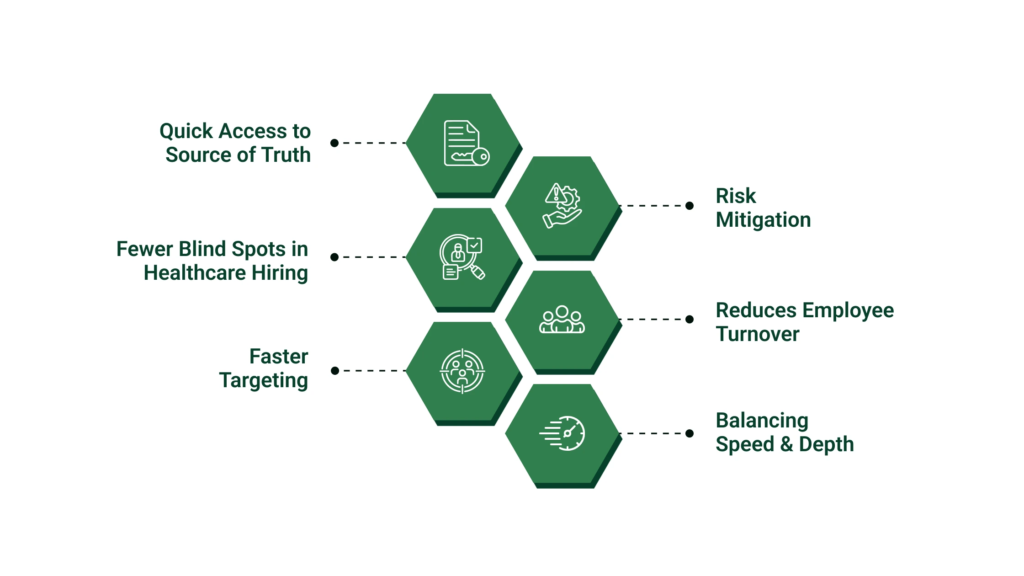
Healthcare employers face unique challenges when hiring for patient-sensitive roles. County-level criminal searches go beyond broad databases to provide the most direct, up-to-date look at a candidate’s history. That level of precision is why they are considered essential in the healthcare hiring process.
1. Quick Access to Source of Truth
County-level searches are valuable because they go straight to the courthouse, where records are first filed and most reliably updated. Unlike aggregated databases that depend on voluntary reporting or delayed updates, county systems often contain the original record of a case, complete with current status and outcome. This makes them the most dependable way to confirm details about charges, convictions, and case progress.
For healthcare employers, having access to this “source of truth” means outdated or incomplete data doesn’t cloud screening results. Direct access provides the level of certainty needed when making decisions about candidates who may interact directly with patients or sensitive medical information.
Major advantages of county-level records include:
- Direct retrieval from official court sources.
- Timely updates reflecting the most recent case activity.
- Reduced risk of relying on partial or mismatched data from third-party databases.
Healthcare organizations use this accuracy to protect both patients and their own credibility, knowing they are relying on verified information from the primary source.
2. Fewer Blind Spots in Healthcare Hiring
County-level checks give healthcare employers visibility into areas that broader systems may overlook, not just by providing the data, but by showing exactly where the record originated. This clarity helps reduce confusion over a candidate’s history, especially in roles where patient trust is paramount.
Instead of relying on general searches that leave recruiters wondering if something was missed, county records close the gap. The ability to trace results back to a specific jurisdiction eliminates ambiguity and ensures that hiring teams review information with full context. That transparency supports confident decision-making while keeping the screening process efficient.
3. Faster Targeting
County-level checks are most effective when focused on the jurisdictions that actually matter. Instead of spreading resources across every possible county, employers can direct searches to the places most likely to hold relevant records. This approach shortens turnaround time and avoids unnecessary steps that slow down healthcare hiring.
How targeted county checks speed results:
- Prioritize relevant jurisdictions – Focus only on counties where candidates have lived, worked, or studied.
- Eliminate wasted searches – Avoid running checks in counties with no connection to the candidate.
- Accelerate decision-making – Results from the right counties arrive sooner, keeping the hiring process on track.
- Integrate with address history tools – An SSN trace can serve as a guide, pointing to the specific counties that should be prioritized.
This blend of targeted county-level checks, supported by address history, gives healthcare employers a faster, more streamlined process while still maintaining the depth of screening required for patient-sensitive roles.
4. Risk Mitigation
Healthcare employers carry a higher duty of care than most industries. Patient-facing roles often involve working with vulnerable individuals, handling sensitive information, and operating in environments where trust is paramount.
County-level criminal searches play a vital role in mitigating the risks associated with these responsibilities, as they provide employers with direct and current records that broader systems may overlook.
Ways county checks help manage risk:
- Lower chance of oversight – Localized searches reduce blind spots by capturing charges and dispositions that have not yet been reported to national repositories.
- Protect institutional reputation – Thorough checks reduce the chance of headlines that damage community trust and patient confidence.
- Minimize operational disruption – Identifying issues earlier prevents rework or last-minute staffing changes that affect patient care delivery.
- Support consistent practices – Applying county-level checks across sensitive roles creates a standardized approach to screening, thereby reducing the likelihood of errors or inconsistencies.
While no process eliminates risk, healthcare organizations use county-level searches to ensure they are making decisions with the most reliable information available. This proactive step helps protect patients, staff, and the facility’s reputation.
5. Reduces Employee Turnover
High turnover is one of the most costly challenges in healthcare. When employees leave soon after being hired, or must be dismissed because of overlooked issues in their background, the organization loses far more than just the role itself. The costs of recruiting, onboarding, and training quickly add up, while the remaining staff are left to carry the workload in the meantime.
County-level criminal searches support stronger hiring decisions by uncovering accurate and jurisdiction-specific information that broader checks may miss. This helps employers avoid situations where overlooked details lead to quick exits or disciplinary dismissals.
How county-level searches help reduce turnover costs:
- Prevent short-term attrition – Clearer background information reduces the chance of candidates leaving soon after hire.
- Cut rehiring expenses – Avoiding rework saves time and money that would otherwise be spent on repeated recruitment cycles.
- Protect team morale – Fewer disruptive exits help maintain stability among staff who are already stretched thin.
- Preserve patient continuity – Stable staffing ensures patients don’t face disruptions in care due to constant personnel changes.
By minimizing the risk of early departures, healthcare employers can protect their investment in new hires while keeping teams consistent and patient care uninterrupted.
6. Balancing Speed & Depth
Healthcare hiring often comes with urgency. Roles such as nurses, technicians, or patient-care assistants can’t sit unfilled without affecting care delivery. At the same time, shortcuts in screening create risks that healthcare organizations can’t afford. Balancing speed with thoroughness becomes the central challenge.
County-level searches help strike this balance. They ensure employers gain access to the most accurate, localized records without wasting time on unnecessary searches. While some jurisdictions may take longer to return results, structured workflows and prioritization strategies help minimize disruption. When paired with tools like SSN trace or consolidated reporting platforms, employers can reduce turnaround without cutting corners on detail.
Best Practices for Integrating County-Level Checks in Healthcare Roles
Healthcare hiring teams already juggle high volumes, urgent needs, and strict expectations. County-level searches can add reliability, but the way they’re integrated into workflows makes the difference between smooth hiring and repeated slowdowns.
Best practices to follow:
- Define role-based depth levels – Differentiate between highly sensitive, patient-facing roles (like nurses or caregivers) and administrative positions to avoid unnecessary delays.
- Standardize documentation protocols – Ensure that all county search results are logged in a consistent, auditable format to reduce confusion later.
- Create escalation paths for flagged results – Designate who reviews findings, how follow-ups are handled, and how information flows to decision-makers, keeping hiring on schedule.
- Utilize parallel processing – Run county-level checks alongside other verifications (education, employment) instead of sequentially, shortening overall turnaround.
- Monitor turnaround performance by county – Track which jurisdictions consistently take longer and plan staffing timelines with those delays in mind.
- Integrate with onboarding platforms – Connect county searches to HR systems so recruiters and managers can view results in the same place as other hiring data.
These practices enable healthcare employers to embed county-level checks seamlessly and predictably into the hiring workflow.
Build Trust in Every Healthcare Hire With Verification Screening Solutions

County-level searches give healthcare employers the precision needed to protect patient-sensitive roles while keeping hiring timelines on track. Verification Screening Solutions (VSS) helps organizations streamline screening by combining targeted county checks with role-specific workflows that reduce delays and blind spots.
Our services include:
Ready to reduce delays and improve confidence in your healthcare hiring process? Learn how our background screening solutions help you protect patients, support staff, and keep hiring efficiently.