
You’ve done your due diligence, or so you think. The background check comes back clear, the hire is made, and everything looks fine. But weeks later, an incident arises, and only then do you realize a past offense that never showed up in the report. It was a jurisdictional oversight.
Most employers don’t realise how fragmented criminal records are. National and state databases may offer good coverage, but they often miss the whole picture because the source data originates at the county level. If that local jurisdiction hasn’t reported into the larger system, or did so with delays, you’re working with incomplete information.
That’s not a risk you can afford to take, especially for roles involving trust, safety, finances, or compliance. In this blog, we’ll discuss why county-level searches remain the most accurate way to verify a candidate’s criminal background and how overlooking them can expose your business to liability, reputational harm, and costly missteps.
What is a County-Level Criminal Search?
A county-level criminal search is a background check that directly retrieves records from individual county courthouses, where most criminal cases in the U.S. are first filed and processed. These searches access the most up-to-date and complete case information available at the source.
It identifies records tied to:
- Felonies
- Misdemeanors
- Pending or unresolved charges
- Case outcomes
- Sentencing details and probation information
It is important because it provides:
- Primary source accuracy: Most crimes are prosecuted at the county level, so the most complete records reside there.
- Timely updates: County courts update their records more frequently than national aggregators.
- Address-specific targeting: Searches are based on a candidate’s known residence history, increasing relevance and accuracy.
County-level checks may require manual courthouse searches, especially in jurisdictions without digital access. In short, county-level searches are critical to a thorough background screening process, especially for roles where jurisdiction-specific accuracy is non-negotiable.
Understanding the Gaps in National Background Checks
Criminal records in the United States are not maintained in a centralized system. Instead, they are housed across nearly 3,200 county-level jurisdictions, each operating under its own administrative protocols, timelines, and data-sharing practices.
Some counties update their records daily. Others may take weeks or even months. A few don’t report to broader databases at all.
These inconsistencies create a significant challenge. No national or state-level background check can guarantee complete accuracy unless localized searches at the source support it.
Case outcomes may also be labeled or entered differently, which can lead to:
- False positives: A candidate is flagged for a charge that was dismissed or reclassified, but the context is missing.
- Missed records: Databases may fail to match a case due to spelling inconsistencies, alias use, or lack of updated identifiers.
- Incomplete results: Without direct access to court records, databases might omit final case outcomes or sentencing information entirely.
This fragmented structure doesn’t just create administrative headaches; it introduces real operational risk. When employers rely solely on aggregated or national-level searches, they often make hiring decisions based on outdated, partial, or misinterpreted data.
That’s why county-level searches are the accuracy anchor in any responsible background screening process.
Why County-Level Detail Matters for Jurisdiction-Specific Accuracy?
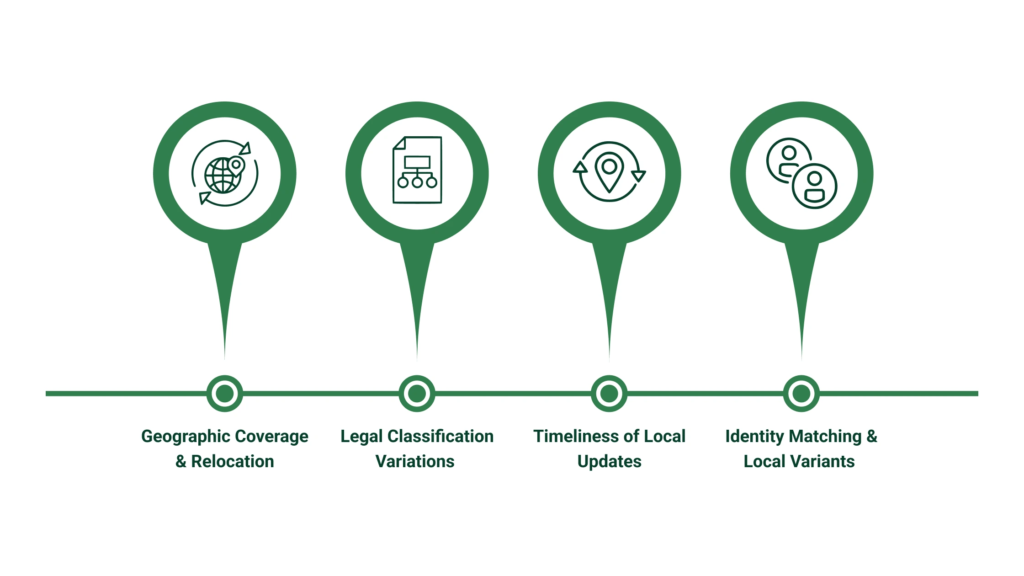
Jurisdictional differences can lead to blind spots, missed records, or misinterpreted information. Below are several real-world scenarios where county-level accuracy makes a measurable difference in hiring decisions.
1. Geographic Coverage & Relocation
Candidates often move between counties for work, school, or personal reasons. However, criminal records typically don’t follow them. A statewide or national criminal database might miss offenses filed in jurisdictions not reporting into the system or those with significant data lags.
Without jurisdiction-specific searches, employers risk overlooking critical information tied to previous residences or regions of activity.
County-level checks fill this gap by targeting locations based on verified address history, ensuring no local courthouse record is unintentionally bypassed. This level of precision becomes especially important when hiring for roles with public interaction, financial access, or safety responsibilities.
2. Legal Classification Variations
Criminal offenses aren’t always classified the same way from one county to another. What one jurisdiction categorizes as a misdemeanor, another may escalate to a felony based on local statutes, thresholds, or prosecutorial discretion.
These differences can significantly affect how a charge appears on a broader report. Relying solely on statewide or national databases risks misinterpreting the seriousness of a case or missing it altogether if it doesn’t meet a state’s reporting criteria.
County-level criminal searches provide the clearest context by capturing how a charge was handled locally, not how it was generalized through data aggregation. This ensures hiring decisions are based on accurate, jurisdiction-specific interpretations rather than potentially misleading summaries.
3. Timeliness of Local Updates
Not all counties report updates to criminal records on the same schedule. This delay can cause critical case developments like new charges, court decisions, or dismissed cases to be missing from aggregated databases at the time of screening.
A county-level criminal search accesses records directly at the source, offering a more current view of a candidate’s background. This reduces the risk of making decisions based on outdated or incomplete data.
Examples of time-sensitive updates often missed in broader checks:
- Recent arrests or arraignments
- Court outcomes which are not yet been sent to state systems
- Dismissed charges still appear as open in older data
- Warrants issued but not yet logged nationally
Hiring based on stale or lagging data can introduce liability, especially in regulated or safety-sensitive roles. County-level access helps close those gaps.
4. Identity Matching & Local Variants
One of the most overlooked risks in background screening is misidentification, mainly when relying on aggregated databases that depend on exact name matches or limited identifiers. Candidates with common names, spelling variations, aliases, or past address changes are particularly prone to mismatches or being missed altogether.
County-level searches improve accuracy by tying identity verification to jurisdiction-specific records that include full names, date of birth, case numbers, and address history. This direct access helps screeners: \
- Detect alternate names or known aliases tied to local filings
- Resolve misspellings or clerical errors not corrected in state/national databases
- Avoid false positives involving unrelated individuals with similar names
- Reduce the risk of overlooking a relevant record due to outdated address linkage
Using county-level records reduces uncertainty and brings clarity to a process where minor data mismatches can lead to significant hiring errors.
Operational Impacts of Inaccurate Jurisdiction Coverage
When background checks lack accurate, jurisdiction-specific detail, the consequences aren’t just limited to screening quality; they disrupt hiring workflows, introduce risk, and erode trust in the screening process itself.
Relying on broad, aggregated databases can lead to:
- Hiring delays triggered by mismatched identities or missing case resolution data
- Misclassification of offenses, such as confusing a dismissed misdemeanor with an active felony, due to inconsistent data
- Breakdowns in auditability, where adverse actions are taken based on unclear or unverifiable information that can’t be sourced back to a specific jurisdiction
These issues strain HR teams, damage candidate experience, and increase the potential for avoidable liability. A county-level search strategy helps correct course by grounding the background process in verifiable, localized records.
Best Practices to Ensure Jurisdiction-Specific Accuracy
A jurisdiction-aware screening process requires intentional structure, cross-county awareness, and reliable data pathways. These practices can help ensure your background checks are aligned with where records originate:
- Use address history as a roadmap: Identify all counties tied to a candidate’s past residences, education, and employment, then search those jurisdictions directly.
- Confirm database “hits” at the source: Any potential record found in a national or multi-jurisdictional search should be validated through the appropriate county courthouse to ensure it’s accurate and current.
- Stay informed on local law variations: Legal classifications and reporting practices evolve. Keep screening policies aligned with any updates in local statutes or recordkeeping standards.
- Work with a provider that prioritizes county-level data: Choose a background screening partner that sources information directly from county courts and understands the nuances of localized reporting.
Precision in background screening comes from covering the proper ground with reliable data. A county-specific approach makes that possible.
Strengthen Your Screening Strategy with County-Level Checks from Verification Screening Solutions

Jurisdiction-specific accuracy matters, especially when background data informs critical hiring decisions. County-level criminal searches provide the clarity, completeness, and context that national databases often lack.
Verification Screening Solutions supports employers with reliable, source-level background checks across the U.S. counties.
Our services include:
- County-Level Criminal Searches
- Education Verification
- Employment Verification
- County-Level Civil Searches
- Federal Civil Search
- Federal Criminal Search
- Statewide Criminal Search
- SSN Trace
- Sex Offender
- Multi-State Criminal Search
- Motor Vehicle Report (MVR)
- Fingerprinting
Contact us now to structure a screening approach that fits your hiring goals.